
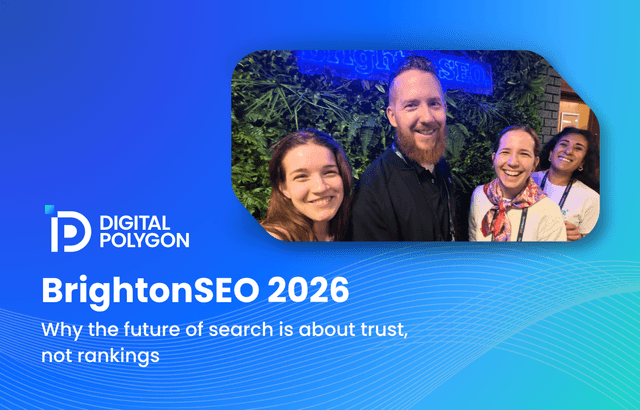
I came into Brighton SEO this year with a working theory and left with it sharpened, validated, and pushed further than I'd taken it myself. That's the best outcome you can ask for from two days at a conference — and it's the reason I'll keep blocking it out in my calendar every year.
Here's what I took away.
Day 1: Better than I expected, and I wasn't expecting much
That's not a slight on Brighton SEO — it's a comment on conferences in general. I've been to enough of them to set my expectations modestly. You go for one or two genuinely good talks, a handful of useful conversations in the hallway, and a refreshed sense of what the rest of the industry is thinking about.
Day 1 cleared that bar in the first session and kept clearing it.
The content was tighter than I remember it being in previous years. Less "here's the framework I built last quarter," more "here's what's actually changing about how people use search, and here's what we're doing about it." The signal-to-noise ratio was high. By the end of the day I had more notes than I usually take across an entire conference, and a list of three or four things I wanted to test as soon as I got back.
So I walked into Day 2 with high expectations. A risky position.
Day 2: The morning that pulled it all together
The opening sessions on Day 2 were the moment the conference clicked into something larger than the sum of its parts. Four speakers, each coming at the future of search from a different angle, and somehow all landing on the same underlying point.
Erin Simmons opened with "The future of SEO is trust-centered — and this is how you become the trusted answer." Her argument was that the era of optimising for rankings is collapsing into something more fundamental: optimising to be the source that AI systems and humans both decide to trust. Trust isn't a soft metric anymore. It's the metric.
Alex McKenna followed with "Search: The Next Generation" — a clear-eyed look at where search is going as the SERP itself becomes less central. The takeaway that stuck: we're moving from a world where users came to a search box, to one where search is happening inside every interface, every assistant, every workflow. If you're still building only for the ten blue links, you're building for a surface that's shrinking.
Samanyou Garg then gave the talk I'd been quietly hoping someone would give: "We Sent AI Agents to Win AI Search. Here's What Actually Happened." Less theory, more empirical — what happens when you actually test how AI agents discover, evaluate, and recommend brands. The findings were uncomfortable in the right way. The brands AI surfaces aren't always the brands with the best SEO. They're the brands with the strongest distributed presence — recognised across communities, cited in third-party sources, talked about in places they don't own.
Becky Simms closed the loop with "Human-First Discovery: Designing the Future of Search." Her framing brought it back to the people. The platforms can change, the algorithms can change, the interfaces can change. What doesn't change is human behaviour — and any strategy that doesn't start there is going to keep getting blindsided every time the platforms shift.
Humans, to data, to AI agents, back to humans. A full loop in 80 minutes.
What I'm taking home
Three things, all variations on the same theme.
Stop building to platforms. Build to behaviour. Platforms are downstream of how people actually want to find, evaluate, and act on information. We've been organising our work around the wrong axis. The platforms will keep changing — the behaviour is the constant.
Meet your communities where they are. Then build your own. Owned audiences are about to matter more, not less. In an AI-mediated world where third-party signals form the trust layer, the brands with engaged communities and a recognisable voice outside their own channels are the ones that get surfaced. The ones that only exist on their own .com are going to be invisible.
Earn voice and recognition outside your brand channels. This is the hardest one and the most important. Mentions, citations, conversations happening about you in places you don't control — these are the inputs AI is increasingly using to decide what's credible. PR, community, partnerships, genuine relationships with creators and journalists. The unsexy stuff is about to become the most strategic stuff.
Most of this sharpens what I've been saying for the last year. Some of it pushes the thinking further than I'd taken it myself. That's exactly what you want from two days like this.
My hot take
This isn't just a conference marketers need to be at. It's one you can't miss.
The reason: the pace of change in search right now is too fast to navigate by reading takes online a quarter after the fact. The conversations happening in the hallways of Brighton SEO are the ones shaping what the rest of the industry will be talking about in six months. If you're serious about this craft, you need to be in the room.
See you at the next one.
Build Better Together
We’re more than an agency. We’re a partner in your growth. See how our commitment helps remodeling businesses scale.