

For years, marketing directors have reported on "organic traffic" and "keyword rankings" to justify their budgets. In the modern era of Revenue Operations (RevOps) and AI-driven search, these are vanity metrics. AEO (Answer Engine Optimization) is the emerging discipline of optimizing for AI-powered answer engines like Google's AI Overviews and ChatGPT Search, and it's reshaping how revenue-focused marketing leaders think about organic performance.
Measurement Matters
Aligning your organic strategy with business growth and revenue generation starts with shifting your reporting focus to measure value - not volume. If we were in your shoes, here’s where we’d start.
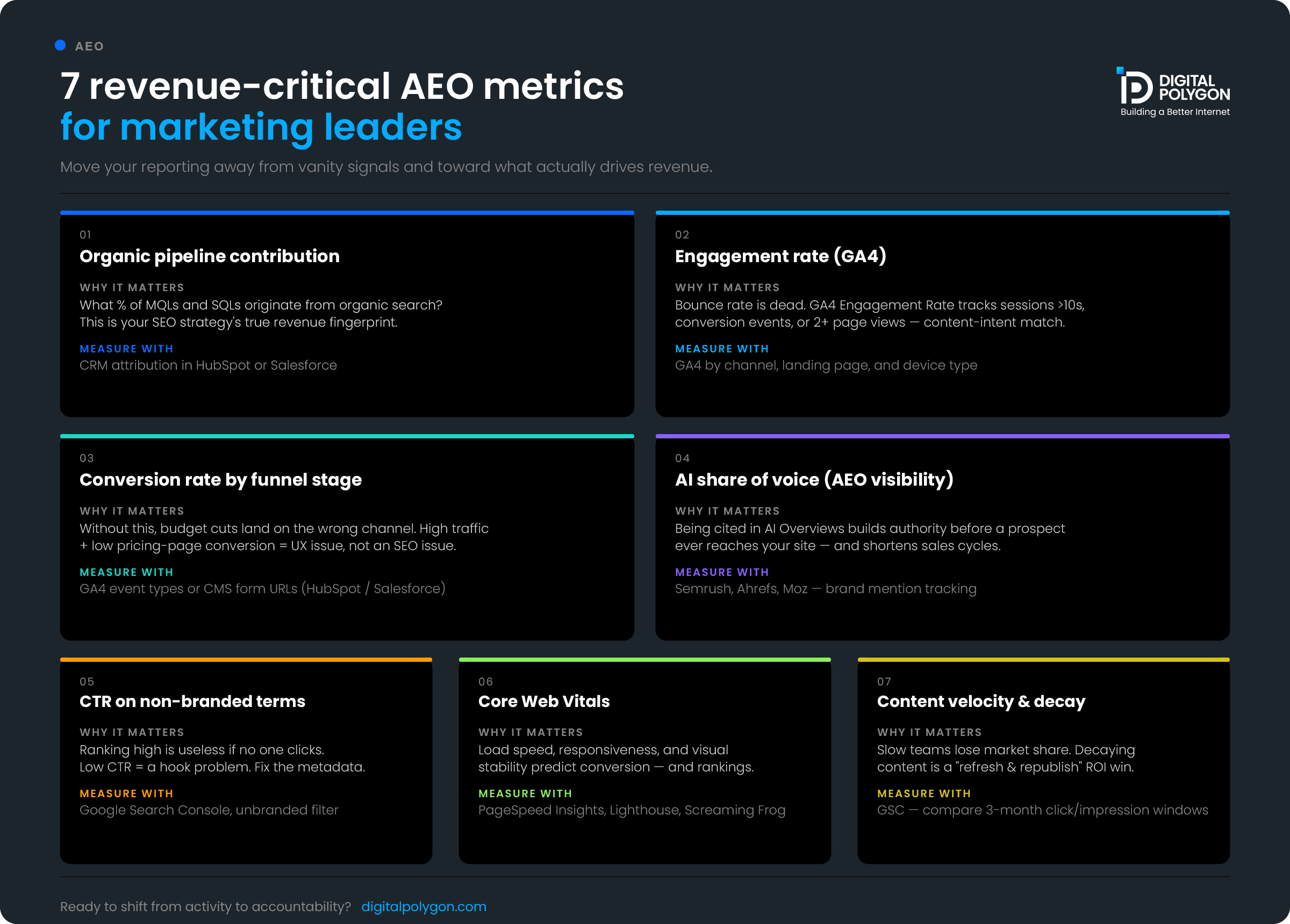
1. Organic pipeline contribution
Instead of only reporting total "users," layer on "pipeline contributions."
Total traffic is irrelevant if it doesn’t convert. The most critical metric for any marketing leader is the percentage of organic traffic and organic-sourced contacts that enter your sales funnel.
Why it matters
Using tools like HubSpot, you can attribute closed-won deals back to the specific page a user entered your site on or began their journey. Connecting the dots from inbound organic traffic to the sales pipeline shows that your AEO strategy is driving sales, not just inflating server logs.
2. Engagement rate (GA4)
Bounce rate? Not as important.
Collectively, we should leave “Bounce Rate” behind with Universal Analytics. In Google Analytics 4 (GA4), Engagement Rate is the new standard for measuring traffic quality. This metric is calculated by finding the percentage of sessions that:
- Lasted longer than 10 seconds
- Had a conversion event, or
- Had two or more page views.
Why it matters
A high engagement rate signals to Google (and your team) that the content matches user intent. For AI search, strong engagement signals reinforce Google’s perception of your content’s quality and relevance - directly supporting your E-E-A-T (Experience, Expertise, Authoritativeness, Trustworthiness) standing. If users engage, you rank.
3. Conversion rate by funnel stage
Differentiate and track conversion rates across the user funnel
A generic "site-wide conversion rate" often hides poor performance. Modern marketing leaders must segment conversion rates by user journey stage, from awareness to consideration and final decision-making. For example, a strong newsletter open rate or high scroll depth may indicate top-of-funnel interest but becomes less impressive when the CTA completion rate (demo requests, contact us form submissions) remains low.
Why it matters
Without this visibility, budget cuts land on the wrong channel and real friction goes unaddressed. High traffic with low conversion on a pricing page is a pricing or UX problem—not an organic strategy one. This clarity protects your budget and aligns your efforts with actual pipeline growth.
Curious about conversion funnels and optimizing conversion rates? Check out our in-depth CRO guide to learn new strategies to fully leverage your digital assets.
4. AI Share of voice (AEO visibility)
Track the depth and quality of citations in AI-generated and supported answers
As search engines evolve into Answer Engines (like Google’s AI Overviews or ChatGPT Search), "Position 1" is being replaced by "The Answer”, underlying the importance of optimizing for zero-click searches.
Why it matters
Being the cited authority in an AI overview builds brand visibility that no paid placement can replicate. When your brand is cited in an AI Overview for a high-intent query—“best CRM for mid-market teams,” for example—you capture that visibility even when no one clicks a traditional result. Over time, consistent citation builds the kind of brand authority that shortens sales cycles and earns trust before a prospect ever reaches your site.
5. Click-through rate (CTR) for non-branded terms
Measure content performance on the terms that matter
Ranking high is useless if no one clicks. CTR on non-branded terms is a direct measure of your message resonance with audiences that are not familiar with your brand.
Why it matters
A low CTR on a high-ranking page indicates a "hook" problem, meaning you are losing out on potential, valuable traffic. Optimizing metadata is often the fastest way to increase traffic without creating new content.
6. Core Web Vitals (CWV)
Technical site health directly impacts user experience and revenue generation
While often viewed as a technical metric, Core Web Vitals (content load speed, page responsiveness, and site stability) is a direct proxy for user experience and a strong predictor for how likely a user is to stay on a page and ultimately convert. It cover three signals:
- Largest Contentful Paint (load speed)
- Interaction to Next Paint (responsiveness)
- Cumulative Layout Shift (visual stability)
Poor scores on any of these directly affect both rankings and conversion rates.
Why it matters:
If your page shifts while loading or takes three seconds to respond, users may bounce before they convert, signaling to Google that your content is lower value or irrelevant.
7. Content velocity and decay
How fast can you publish, and how long does it last?
Tracking time-to-publish (velocity) and content decay (traffic loss over time) reveals your team’s ability to effectively publish new, engaging content as well as how quickly this content loses visibility in search.
Why it matters
Operational efficiency is key to scaling. If it takes your team three weeks to publish a blog post, you are losing market share. Conversely, identifying decaying content allows you to "refresh and republish" for a quick ROI win, costing significantly less than creating net-new assets.
From activity to accountability: Your next step
The seven metrics above represent a fundamental shift in how marketing leaders measure and communicate the value of organic search. Taken together, they move your reporting from “how much traffic did we get” to “how much revenue did we generate”—a conversation that resonates in the boardroom and drives smarter investment decisions.
If you’re not sure where to start, begin with organic pipeline contribution and engagement rate. These two metrics alone will give you a clearer picture of what your content is actually producing. From there, layer in the remaining five as your reporting matures.
Ready to audit your current answer engine reporting and identify the gaps? Our team can help you build a revenue-aligned measurement framework tailored to your funnel. Get in touch to start the conversation.
Is your AEO reporting proving revenue — or just activity?
We'll audit your current metrics and build a reporting framework that connects organic search to pipeline.